

When we step on a scale, we usually see only one number: body weight. Yet this tells us surprisingly little about body composition. Bioelectrical impedance analysis of body composition is a widely used method in professional settings for monitoring changes in the body, and in recent years, in simplified form, it has become increasingly common outside professional environments as well.
It is based on the passage of a very weak alternating electrical current through the body, which we cannot detect. The device measures how the body resists this current and how the current behaves in different tissues. Water and muscle tissue allow easy passage, while adipose tissue slows it down somewhat. Based on this response, the device uses mathematical models and algorithms to calculate an estimate of body composition.
These equations are based on averages and assumptions that are reliable at the population level, but require thoughtful interpretation of results in individuals, regardless of measurement frequency [1,2].
Types of Bioelectrical Devices for Measuring Body Composition
Various bioelectrical devices exist on the market, differing primarily in the path the electrical current takes through the body. Classic bathroom scales measure between the feet, so the result largely reflects the properties of tissues along this path. Handheld models work between the hands and are more tied to the upper body. More advanced devices with electrodes for both hands and feet capture the entire body and provide insight into the distribution of body composition across individual body parts.
In clinical settings, such measurements are often performed in a lying position, with electrodes on the wrist and ankle, which enables more standardized measurement conditions.
All these devices are based on the same basic principle; they differ only in the path of the electrical current and the algorithms used. Precisely because of these differences, results between devices are not directly comparable. When changing scales, we therefore do not continue the old sequence of measurements, but start a new sequence [3].
For a more in-depth assessment of body composition, devices are used that measure bioimpedance with multiple frequencies and with electrodes for both hands and feet. This type of measurement enables capture of the entire body and better insight into the distribution of body water, which contributes to more stable calculations of lean mass and body fat.
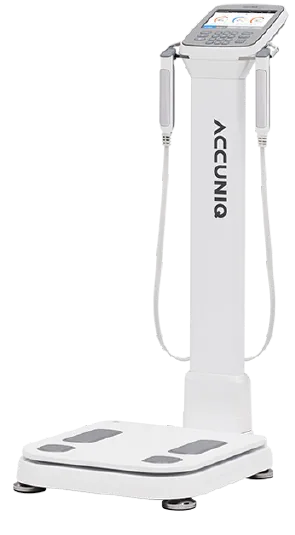
One such system is Accuniq, used in professional and clinical settings. Measurement is performed standing, with gripping of hand electrodes and foot contact with the measuring platform, so electrical current travels through the entire body – not just the lower or upper part. The use of multiple frequencies enables separation between intracellular and extracellular water, and thus more accurate interpretation of body composition.
Advantages of Bioimpedance Analysis
Bioimpedance analysis has some very practical advantages:
- it is non-invasive, quick, and accessible,
- it allows repeated measurements under comparable conditions,
- and is useful for observing changes over time.
Research shows that BIA devices are quite reliable for repeated measurements under the same conditions. Deviations are small, and trends generally follow actual changes in body composition well [4]. Such advantages come to the fore especially with multi-frequency, whole-body measurements, as enabled by professional devices like the ACCUNIQ BC380. In these cases, measurement has the greatest value as part of long-term observation of changes, not as a one-time data point.
Limitations We Need to Know
Bioelectrical impedance analysis is a non-invasive and safe method, but is not used in people with implanted electronic medical devices, such as a pacemaker or cardioverter-defibrillator. In pregnant women, measurements are generally not performed.
Results are sensitive to several factors, including:
- hydration,
- recent physical activity,
- meals,
- alcohol,
- menstrual cycle phase,
- and even skin temperature.
After intense exercise or a large meal, the calculated body fat percentage can change, even though body composition has not actually changed, but only the distribution of body water [2].
In children and adolescents, elderly people, and highly trained individuals, bioimpedance analysis results may be less accurate than in the general adult population. The reason is that body ratios, water distribution, and muscle mass percentage in these groups differ from the averages on which calculations are based. Therefore, in these groups, measurement is primarily indicative and has the greatest value as part of comparing consecutive measurements.
How Often to Measure
It makes sense to perform measurements under comparable conditions:
- at approximately the same time of day,
- in a similar state (e.g., in the morning, fasting, in light clothing),
- and always with the same device.
Body composition measurements do not need to be performed frequently. For most people, occasional body composition checks are perfectly sufficient, for example during major lifestyle changes or at longer time intervals, such as once to twice a year. More frequent measurements rarely provide additional useful information and can quickly lead to excessive focus on numbers.
It is different during periods when the goal is body weight regulation. In such cases, more frequent weighing can be beneficial, as it supports awareness and self-regulation. Even then, individual measurements are not crucial – what matters is focus on averages and long-term trends, not daily fluctuations. Scientific reviews show that regular weighing can support body weight regulation when it is part of a broader, reasonably designed approach [5].
How to Read Bioelectrical Impedance Analysis Results
- A single measurement provides an indicative insight into current body composition.
- It makes sense to compare results over time, with measurements under comparable conditions.
- Results between devices are not directly comparable.
- It is recommended to perform measurements in the morning and fasting, as consumed liquids, meals, and physical activity affect results.
References
- Kyle UG et al. Bioelectrical impedance analysis – Part I: Review of principles and methods. Clinical Nutrition, 2004.
- Kyle UG et al. Bioelectrical impedance analysis – Part II: Utilization in clinical practice. Clinical Nutrition, 2004.
- Bennett JP et al. Variations in bioelectrical impedance devices impact raw measures comparisons. Clinical Nutrition ESPEN, 2024.
- Siedler MR et al. Assessing the reliability and cross-sectional and longitudinal validity of fifteen bioelectrical impedance analysis devices, British Journal of Nutrition, 2022.
- Madigan CD et al. Is self-weighing an effective tool for weight loss? Int J Behav Nutr Phys Act, 2015.