
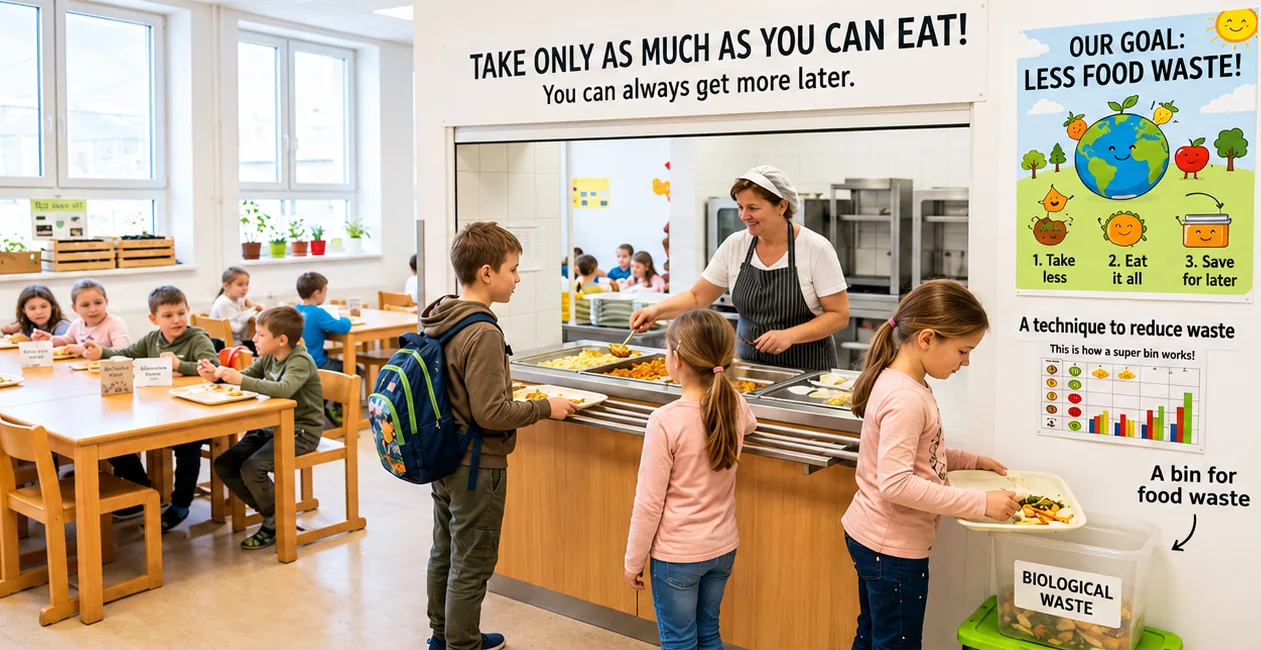
According to data from the Slovenian Environment Agency (ARSO), approximately 79,600 tons of biodegradable kitchen waste and restaurant waste, registered under code 20 01 08, were collected in Slovenia in 2024. Almost two-thirds originated from households, which we will focus on more at another opportunity. Among other activities, most of this waste came from hospitality, followed by education with almost 5,700 tons. Education thus represented approximately 21% of the amount of this waste collected outside households [1].
Economic Consequences of Food Waste
What do these amounts mean for nutrition costs in educational institutions? The purchase value of discarded food is only part of the loss, as labor, energy, and other resources have already been invested in its storage and preparation, followed by waste management costs. We did not find comprehensive estimates of these costs for Slovenian educational institutions in the reviewed literature, but their scope is illustrated by individual European studies.
In a study of Italian school nutrition, it was estimated that 6–11% of total meal costs were associated with unserved food and leftovers on plates [2]. In a Portuguese study published in 2025, the value of discarded food for the main course was estimated at approximately 0.32 euros per lunch served, excluding labor and energy costs for preparation [3]. An analysis by Ecologists Without Borders in eight units of the Škofja Loka Kindergarten also identified opportunities for savings by improving the meal cancellation system and adjusting served quantities to actual needs [4].
With the large number of meals that kindergartens and schools prepare every day, even a small loss per individual meal can mean considerable costs over the year. By reducing food waste, part of the funds that today end up as waste could be allocated to higher quality foods, a larger share of local and organic food, or upgrading kitchen equipment. Monitoring leftovers is therefore not only an environmental measure but also an opportunity for better use of available resources. The savings we could achieve in an individual institution can be estimated based on data about what food remains, where, and how much.
Where Does Food Waste Occur in Educational Institutions?
ARSO data includes both edible and inedible parts of food, so the total collected quantities cannot be equated with food whose disposal could have been prevented. For a broader framework: according to an estimate by the Statistical Office of the Republic of Slovenia, in 2025 the edible part represented 36%, and the inedible part 64% of all food waste in Slovenia [5]. We do not know this ratio for educational institutions, but the estimate illustrates the importance of distinguishing between the two parts.
Kitchen waste occurs at different stages: during food storage, during meal preparation, as unserved food, and as leftovers on plates. The reasons for occurrence differ between individual stages:
- food storage – spoilage, late consumption, excessive inventory, or inadequate storage conditions
- meal preparation – removal of inedible parts such as bones and peels, as well as edible parts due to excessive peeling, cleaning, and trimming,
- unserved food – preparation of excessive quantities, uncollected meals, late cancellations, or untimely transfer of information about children's absence to the kitchen,
- leftovers on plates – portions that are too large, rejection or unfamiliarity with dishes, intervals between meals that are too short, insufficient time for eating, or inappropriate atmosphere during the meal.
Each of these stages requires different measures, which we present in detail below. If we don't know where and why food remains, we may invest time and effort in changes that don't address the main cause. The findings of the Court of Audit from 2018 also show that merely implementing activities is not enough: the reviewed primary schools made efforts to reduce leftovers, but did not systematically monitor their occurrence and did not appropriately adjust food handling [6]. Monitoring therefore helps us choose measures according to the actual situation in the institution and verify whether they are effective.
How to Monitor the Amount of Kitchen Waste
For an initial overview, we can separately weigh waste during preparation, unserved food, and leftovers on plates for a few days at lunch. We also record the menu and the number of prepared and served meals.
Why the total amount of waste is not sufficient for selecting measures is illustrated in Figure 1. In both institutions, the amount of kitchen waste is the same, but in institution A, leftovers on plates predominate, so we would check portions, acceptability of dishes, and eating conditions. In institution B, unserved food predominates, so we would check quantity planning and meal cancellations.
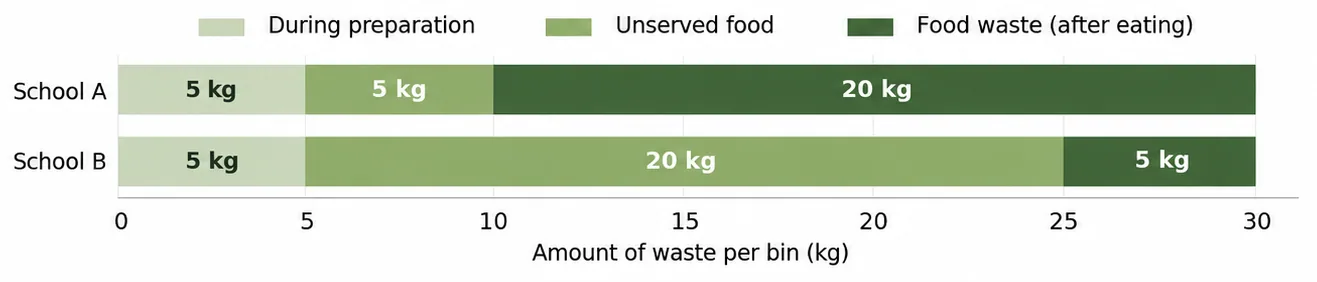
Figure 1: Illustrative example of kitchen waste distribution at lunch. Data is fictitious.
Monitoring can be organized as a project week, involving management, nutrition organizer, kitchen staff, professional/pedagogical workers, children, and parents. The nutrition organizer coordinates tasks: kitchen staff weighs waste during preparation and unserved food, while professional staff helps weigh leftovers after meals.
In schools, we involve students and teachers from different subjects in weighing, calculating quantities per served meal, and preparing graphs. We connect the results with learning content about nutrition, environment, and waste costs, and together propose improvements. We present findings to parents and ways they can participate in reducing food waste. After implementing measures, we repeat measurements with comparable menus and compare quantities per served meal.
We also regularly inform students about results after implementing changes, as feedback can contribute to reducing leftovers. In a European study, this approach reduced plate waste by 17%, and the effect was maintained up to 15 months after implementing the measure [7].
Proposed Measures for Reducing Food Waste in Educational Institutions
Based on collected data, we prioritize measures in stages where most waste occurs and where there are most opportunities for reduction. Below we present some practical measures that we adapt to the identified situation in the institution:
- Preventing waste from inventory – before ordering, we check inventory and adjust quantities to planned consumption. We prioritize using food with the nearest expiration date and ensure appropriate storage conditions. If we determine that a food item's expiration date is approaching, we adjust the menu to use it in time.
- Reducing waste during meal preparation – when cleaning, peeling, and trimming food, we preserve as much of the edible part as possible. For salad, we only remove damaged and unusable leaves, and when removing seeds, pits, bones, and cartilage, we take care not to discard the usable part of the food. We incorporate edible vegetable trimmings into other dishes: we use clean carrot peels for soup base, and broccoli and cauliflower stems for soups or sauces. We collect parts for further use separately and store them appropriately.
- Reducing the amount of unserved food – at the first parent-teacher meetings, we explain to parents the importance of timely meal cancellation and the method of charging for uncanceled meals in accordance with the institution's rules. We enable easy cancellation via app and automatic and timely transfer of data on daily registrations directly to the kitchen, without unnecessary intermediaries. In kindergarten, each group reports the number of actually present children to the kitchen after breakfast. When meal preparation allows, we start preparing most of lunch after receiving this data. We consistently follow quantitative norms, and adjust additional quantities due to transport to actual consumption in individual units and limit them to a minimum. For dishes that regularly remain unserved, based on measured leftovers, we reduce the total prepared quantity.
- Reducing leftovers on plates – when portioning, we consider quantitative norms from the Guidelines [8] and individual children's needs. We offer a smaller initial portion to lighter eaters, and we don't automatically increase portions just because a dish is popular. For breakfast, we ensure at least 15 minutes in school and 30 minutes in kindergarten, for snacks at least 15 minutes, and for lunch at least 30 minutes. We ensure at least a two-hour interval between meals, preferably three. We reduce crowding and noise in the dining room and ensure a calm atmosphere. We introduce less familiar dishes gradually, including with announced tastings and encouraging adult role models. Through weighing, we monitor which dishes remain and how much, and through conversations and surveys, we investigate reasons and improve preparation and serving. We present findings to parents and invite them to encourage children to consume meals and get to know less familiar dishes. They should address any concerns to the nutrition organizer or management, and avoid negative comments about offered food in front of children.
Let's Maintain the Diversity and Nutritional Quality of Meals in Educational Institutions
Let's reduce food waste by improving nutrition organization and supporting children in accepting dishes, not by reducing diversity or deviating from the Guidelines. Implementing the presented measures requires time and cooperation from everyone involved, so offering only dishes popular among children may seem like a simpler solution. However, it does not by itself guarantee fewer leftovers, and it limits children's opportunities to get to know and gradually accept other foods.
Two Slovenian studies also suggest that diverse and nutritionally appropriate offerings do not necessarily mean more leftovers. In the pilot study of the School Plate project, the share of leftovers between regular and adapted, more sustainable lunches did not differ statistically significantly [9]. In doctoral research on the impact of kindergarten nutrition on children's health [10], children consumed more vegetables, whole grains, and nuts with nutritionally more appropriate meals, and the amount of leftovers did not differ statistically significantly between the intervention and control groups [11].
Therefore, when seeking solutions, let's maintain both goals: less wasted food and developing eating habits that support children's health.
At HFL Institute, we help you connect reducing food waste with quality child nutrition through training for employees and parents and menu analysis. Programs are led by Dr. Maja Berlic with over 20 years of experience in organizing nutrition in kindergartens. For an offer tailored to your institution, write to maja.berlic@hflinstitute.eu.
References
- ARSO, Količine zbranih odpadkov 20 01 08 Biorazgradljivi kuhinjski odpadki in odpadki iz restavracij po glavni SKD dejavnosti izvirnih povzročiteljev, Slovenija, 2024. 2026.
- García-Herrero, L., F. De Menna, and M. Vittuari, Food waste at school. The environmental and cost impact of a canteen meal. Waste Manag, 2019. 100: p. 249-258.
- Abreu, M., J. Carvalho, and C. Gonçalves, Evaluation of nutritional and economic impact of food waste in a school canteen. Measurement: Food, 2025. 19: p. 100234.
- Sreš, K. Rezultati spremljanja zavržene hrane v škofjeloških javnih ustanovah. 2022; Available from: https://ebm.si/glavna/web/prispevki/rezultati-spremljanja-zavrzene-hrane-v-skofjeloskih-javnih-ustanovah?utm_source.
- Statistični urad Republike Slovenije. Odpadna hrana, 2025. 2026 2.11.2026]; Available from: https://www.stat.si/StatWeb/sl/News/Index/14625?
- Računsko sodišče Republike Slovenije, Zbirno poročilo: Ravnanje s hrano v osnovnih šolah. 2018.
- Sundin, N., et al., Sustainability assessment of educational approaches as food waste prevention measures in school catering. Journal of Cleaner Production, 2024. 481: p. 144196.
- ZRSŠ, Smernice za prehranjevanje v vzgojno-izobraževalnih zavodih. 2024: Ljubljana.
- Bolha, A., Korošec, M., Čad, E. M., Javno poročilo o sprejemljivosti šolskih kosil (R6). 2025, Univerza v Ljubljani, Biotehniška fakulteta.
- Berlic, M., Vpliv z antioksidanti bogate prehrane v vrtcih na oksidativni stres pri zdravih otrocih. 2024, Univerza v Ljubljani, Biotehniška fakulteta.
- Berlic, M., T. Battelino, and M. Korošec, Can Kindergarten Meals Improve the Daily Intake of Vegetables, Whole Grains, and Nuts among Preschool Children? A Randomized Controlled Evaluation. Nutrients, 2023. 15(18): p. 4088.