
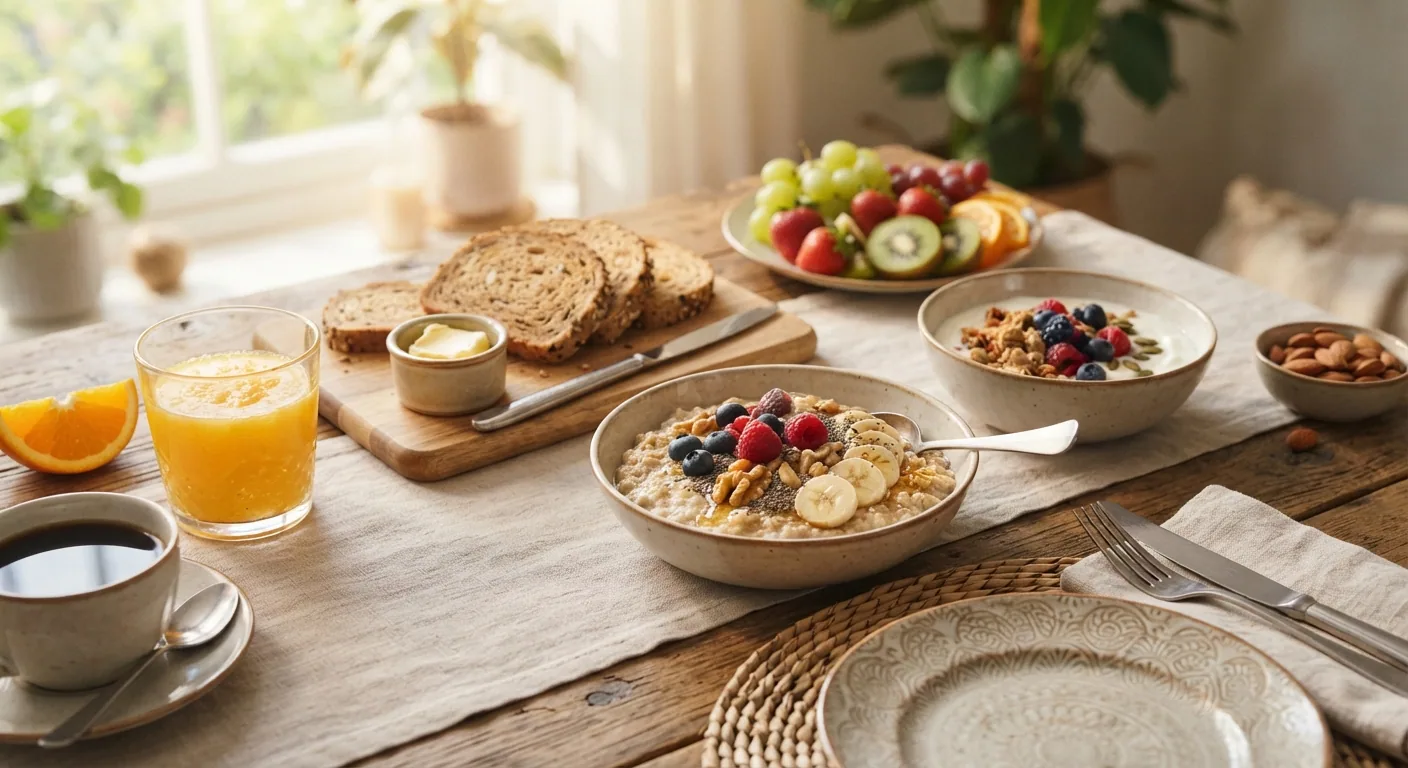
Benefits of Eating Breakfast
- Energy Supply
The body works during the night too. When we wake up, we've already gone several hours without food, and ahead of us lie work, school, and other activities. Breakfast provides us with new energy from food, and if we skip it, the body continues to draw from its reserves.
- Improved Concentration
Breakfast can help us be more focused in the morning. This is especially important for children: research shows that after breakfast, they achieve better results on some attention and memory tasks than when they skip it [1].
- Better Diet Quality
With breakfast, we can offer fruit, whole grains, milk, yogurt, or eggs in the morning. Such a meal provides the child not only with energy but also with proteins, fiber, and vitamins and minerals. Research shows that children who eat breakfast have, on average, a higher intake of some important nutrients throughout the day, including calcium and iron [2].
Skipping Breakfast
Regularly skipping breakfast is not recommended for children. WHO/Europe also includes daily breakfast among healthy eating habits for children [3]. Why we attribute such importance to it, we've already seen above: breakfast can benefit morning concentration and help with the intake of important nutrients.
As adults, we already have established eating habits, and for some, a morning without breakfast suits them perfectly. In this case, it's important to consume enough energy throughout the day from nutritionally well-composed meals. It's worth knowing that research links regularly skipping breakfast with an increased risk of type 2 diabetes [4].
When to Eat
Although there's no exact time set for breakfast, let's try to eat it within the first two hours after waking up, especially when a long morning awaits us until the next meal. This is a practical guideline, not a strict rule we must follow at all costs. If a child has breakfast at daycare soon after waking up, they don't need to be offered breakfast at home. If daycare breakfast is late, they should have breakfast at home.
However, it's very important to help children establish a breakfast routine in early childhood. That family habits can be important later is shown by research in which children who had breakfast with their parents at age ten were more likely to have breakfast at age sixteen [5]. Maintaining the habit of eating breakfast is also important in adolescence from the perspective of healthy eating habits.
If it still doesn't work in the morning despite all efforts, prepare a breakfast to go for a student or yourself. Children can eat it during the first break instead of waiting for the first meal until organized school snack time, and adults as soon as we feel hungry.
What to Eat
As with other meals, it's also advisable to offer diverse foods for breakfast, from which children and adults get energy and various nutrients. It's beneficial for it to contain a source of fiber and a source of protein, and if possible, fruit or vegetables. This makes it easier to compose a nutritious meal that will satisfy us until the next meal.
The options are quite ordinary:
- millet porridge with milk, dried plums, and walnuts;
- whole grain bread with chickpea spread, cherry tomatoes, and a pear;
- whole grain toast bread with cheese and sliced kohlrabi;
- bread with peanut butter and an apple;
- omelet with leftover vegetables from dinner and a piece of bread.
There's no need to limit yourself to typical breakfast foods. If a child prefers a meal left over from dinner in the morning, you can offer it to them. Do they like sugary cereals? Mix a small amount with a larger amount of unsweetened whole grain cereals.
What's Better to Avoid?
Mainly combinations dominated by sugary drinks, sweet cereals, pastries, or sweet dairy products, with little fiber and protein. Such a breakfast can contain quite a bit of energy, but at the same time, we miss the opportunity to include more nutritious foods in the morning. Fruit juice is also not equivalent to whole fruit: with whole fruit, we also consume fiber. If there are still a few hours until snack time, a croissant with plain yogurt and fruit will be a better choice than a croissant with juice. This doesn't mean a croissant is forbidden. But it does mean that a croissant and juice alone aren't the best solution for every school or work morning.
More ideas for balanced breakfasts can be found in the new Menus section on the HFL Institute website. Every week we publish a five-day menu with breakfast, snack, and lunch or dinner. An interactive shopping list is added to the menu so you can quickly check what you need before going to the store and shorten shopping time.
Prepare for Breakfast the Night Before
There's often enough to do in the morning without thinking about what we'll eat. If we only start thinking about breakfast then, we can easily skip it due to lack of time. Therefore, the simplest habit is to take a few minutes in the evening and decide what we'll prepare in the morning for ourselves and our family. Cut fruit for yogurt or cereal, prepare vegetables and spread, or mix batter for pancakes or kaiserschmarrn. Cover what you've prepared and store it in the refrigerator. In the morning, you'll be glad you took care of this the night before.
References:
- Adolphus, K., et al., The Effects of Breakfast and Breakfast Composition on Cognition in Children and Adolescents: A Systematic Review. Adv Nutr, 2016. 7(3): p. 590s-612s.
- Giménez-Legarre, N., et al. Breakfast Characteristics and Its Association with Daily Micronutrients Intake in Children and Adolescents–A Systematic Review and Meta-Analysis. Nutrients, 2020. 12, 3201 DOI: 10.3390/nu12103201.
- WHO/Europe. How healthy are children's eating habits? – WHO/Europe surveillance results. 2021 24.september 2026]; Available from: https://www.who.int/europe/news/item/03-03-2021-how-healthy-are-children-s-eating-habits-who-europe-surveillance-results?
- Ballon, A., M. Neuenschwander, and S. Schlesinger, Breakfast Skipping Is Associated with Increased Risk of Type 2 Diabetes among Adults: A Systematic Review and Meta-Analysis of Prospective Cohort Studies. J Nutr, 2019. 149(1): p. 106-113.
- Verloigne, M., et al., Family- and school-based predictors of energy balance-related behaviours in children: a 6-year longitudinal study. Public Health Nutr, 2013. 16(2): p. 202-11.