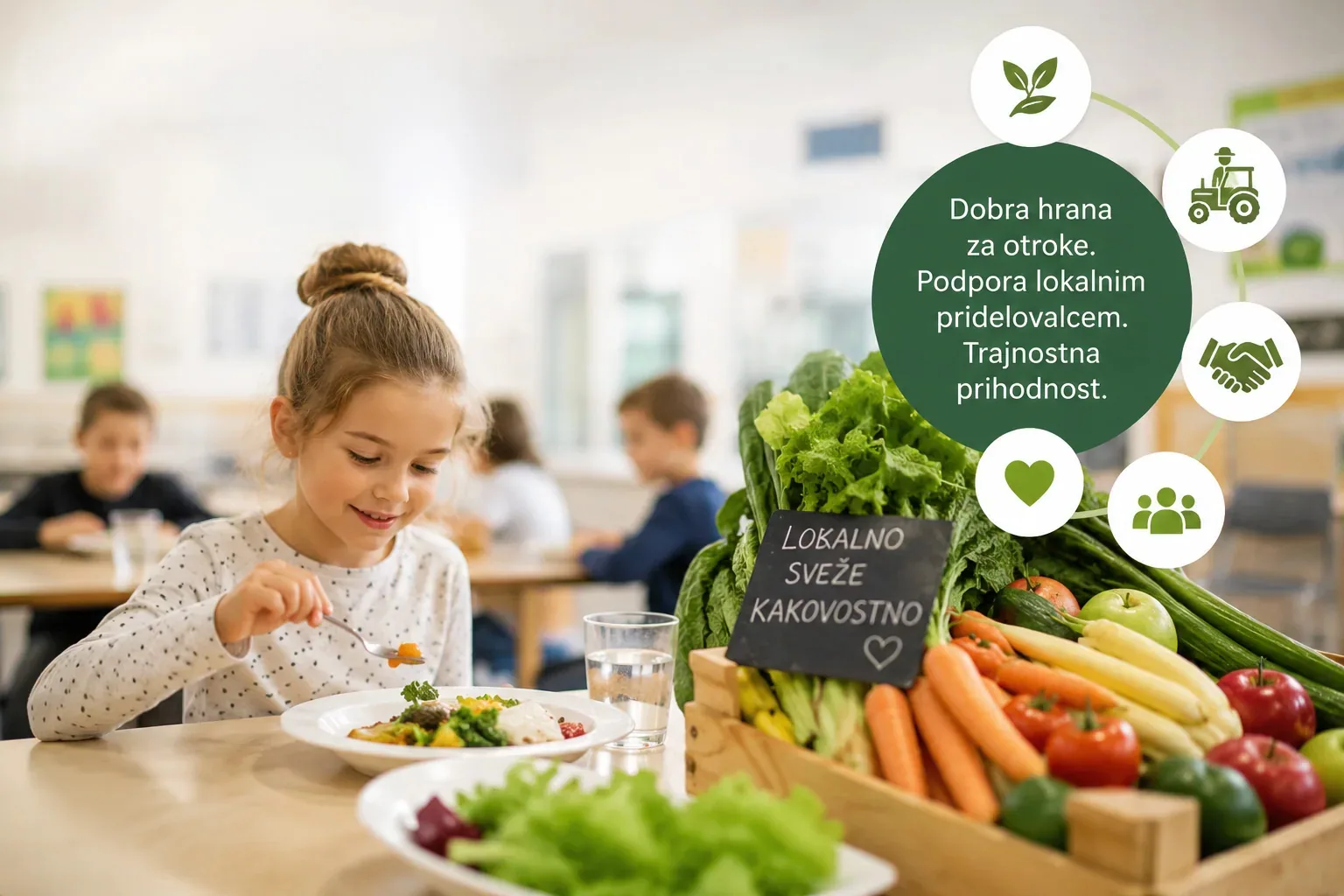
Including local and organic foods in the diets of children in kindergartens and schools is a goal supported by educational institutions (EIs), health professionals, parents, and Slovenian food producers alike. High-quality, safe, seasonal, and local food is important for children's health, the development of nutritional literacy, and long-term support for Slovenian agriculture.
This is precisely why the practical guide How to Get More Local Organic Foods on the Menus in Educational Institutions [1] is so valuable. Also encouraging are the announcements by the Ministry of Agriculture, Forestry and Food (MAFF) regarding new projects to connect Slovenian farmers and public institutions into a more unified food supply chain [2]. Without a more stable domestic supply, appropriate financial incentives, and better coordination between producers and EIs, significant progress cannot be expected.
Public Procurement as the Central Requirement for Food Ordering
There is a widespread public belief that the public procurement system is based primarily on finding the lowest price, which is not the case. For preparing meals in EIs, cooks have on average between 600 and 750 different food items at their disposal, which must be included in the pre-tender forms of the public procurement. When preparing tender documentation, nutrition coordinators therefore invest considerable professional expertise in defining quality criteria, categorising individual foods into procurement lots, and creating separate lots that make it easier to include suppliers from short supply chains.
Suppliers then submit bids for individual food lots and contractually commit to the regular delivery of foods of the agreed quality. The purpose of public procurement is therefore primarily to ensure a reliable supply of food of the required quality at pre-agreed prices.
Even when including local foods in separate lots, EIs must adhere to the same public procurement rules and requirements as for all other foods. It is important to note that local origin in itself does not constitute a quality scheme, and therefore locally produced conventional foods are treated the same as other conventionally produced foods in public procurement procedures.
Public procurement rules also stipulate that identical food items may not be duplicated across different lots. If conventionally produced lettuce is included in the general inventory, it cannot simultaneously be included in a separate lot merely because it is locally produced. However, it is permissible to include conventionally produced lettuce in the main inventory and lettuce from one of the recognised quality schemes in a separate lot.
Why, then, should conventionally produced local lettuce not be included in separate lots to additionally support Slovenian farmers? The reason lies primarily in ensuring a continuous and reliable food supply. At the end of a particular season, it often happens that certain Slovenian foods can no longer be supplied in the required quantities, while the organised feeding of children must take place uninterrupted every day. For this reason, wholesalers play an important role in the current system, as their broader procurement networks make it significantly easier to ensure a continuous supply throughout the entire contract period. The risk of supply disruptions from smaller local supply chains remains considerable under current conditions.
Distinguishing Between Local, Organic, and Quality Scheme Foods
To understand the possibilities and limitations of public procurement, it is important to distinguish between three concepts that frequently overlap in public discourse: local food, quality scheme food, and organic food.
Local food refers primarily to geographic proximity of production or a shorter supply chain. In Slovenia, due to the country's small size, all foods of Slovenian origin are generally considered local. These may be produced conventionally or in accordance with the requirements of various national or European quality schemes. National schemes include, for example, integrated production, higher quality, and selected quality, while European schemes include protected designation of origin, protected geographical indication, and organic production.
Not all quality schemes are tied to Slovenian origin. While some national quality schemes include requirements regarding origin and thus support Slovenian production, organic production as a European quality scheme does not in itself mean that a food is of Slovenian origin. In practice, EIs may therefore sometimes achieve higher shares of organic foods by including organic foods from other EU countries or third countries, such as organic bananas.
If a local food is not included in one of the recognised quality schemes, it is treated the same as other conventionally produced foods from other EU countries in public procurement procedures. The term "local organic food" is often used as a goal, but it does not represent an independent official quality scheme. For this reason, contracting authorities must be very careful when preparing public tenders. Directly favouring Slovenian or local origin is legally sensitive, as the public procurement system is based on equal treatment of tenderers and the prohibition of restricting competition (Article 73 of the Public Procurement Act).
> High Shares of Organic Foods Require Additional Systemic Support
The examples of good practice from the guide [1] importantly demonstrate that progress is possible, but they must also be understood within their actual context. This is especially true for examples of including organic foods within the School Fruit and Vegetables Scheme [3], which represents a separate, additionally financially supported system and is not part of the regular public procurement of organised catering in EIs.
The image below shows an example of a school with a high share of local organic foods. Such a share is achievable in part because the procurement of fruit and vegetables within the School Fruit and Vegetables Scheme is not part of the regular public procurement of organised catering, but instead allows for the direct inclusion of Slovenian producers. Expanding similar schemes to kindergartens and secondary schools could be one of the most effective ways to gradually increase the share of local foods, quality scheme foods, and local organic foods in EIs.
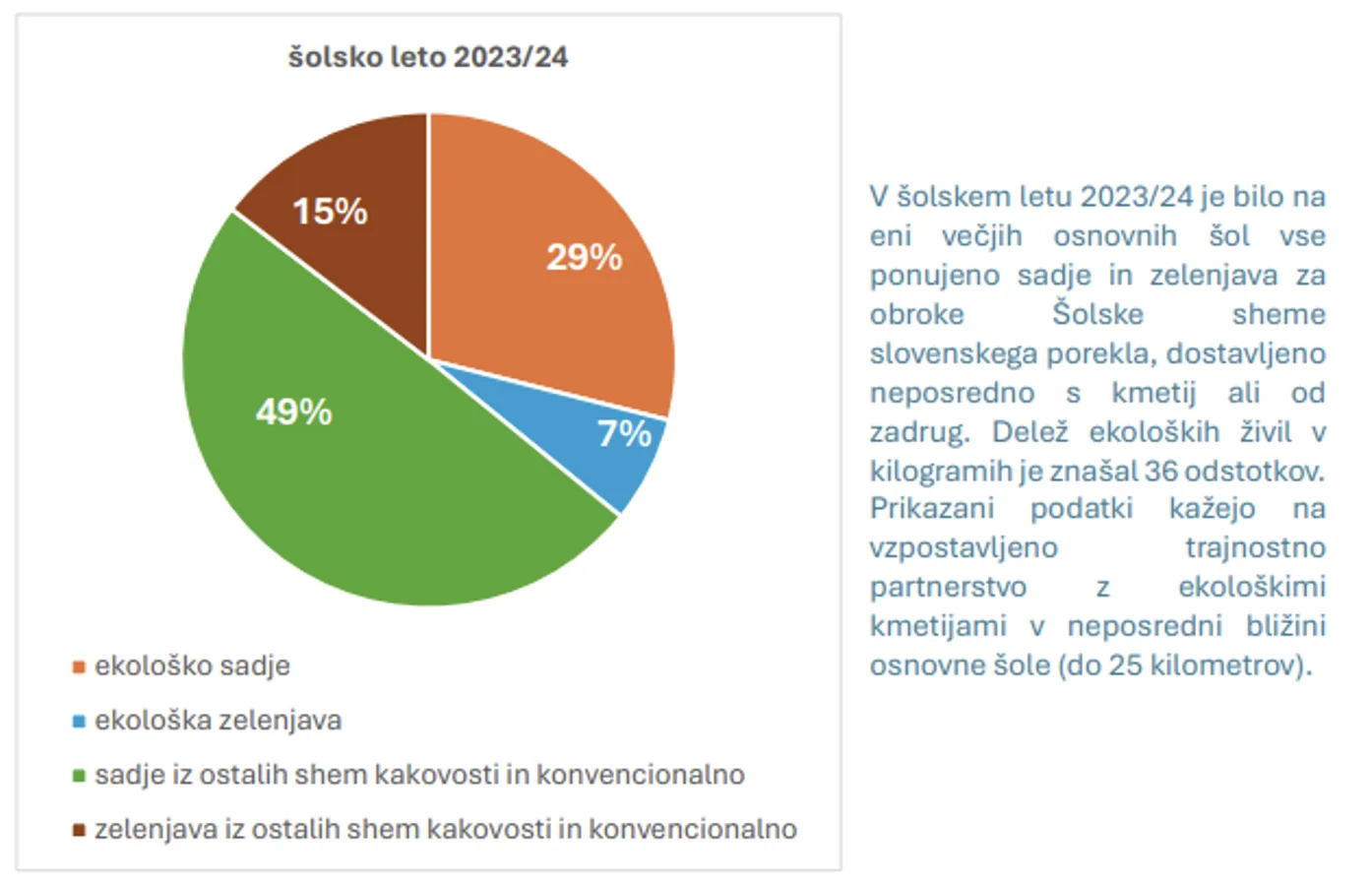
Source: Practical Guide [1]
Why Is the Share of Local Foods in EIs Not Higher?
If we look at the inclusion of local and organic foods primarily from the perspective of regular public procurement under the provisions of the Public Procurement Act — rather than the separately funded School Fruit and Vegetables Scheme — it quickly becomes clear that EIs are constrained in their purchasing primarily by the fact that the system must provide uninterrupted, financially sustainable, and logistically coordinated catering for all children every day. For this reason, organised catering cannot be based solely on the desire for more local and organic foods, but must rely primarily on the market's actual capacity to supply such foods in sufficient quantities throughout the entire delivery period.
Under current conditions, Slovenian supply in many food categories — particularly fruit and vegetables — cannot guarantee this level of system stability. An additional constraint is posed by public procurement itself, which does not allow the direct favouring of Slovenian origin.
Discussions about increasing the share of local organic foods also too often overlook the actual financial frameworks of organised catering in EIs. The funds allocated for food procurement are limited, and price differences between individual local organic foods and imported organic foods can be considerable. This also raises the professional question of proportionality. Local organic food is undoubtedly an important value from the perspective of sustainability and support for the domestic environment; however, the system must simultaneously provide financially sustainable catering for all children every day. Without additional funding, high shares of local organic foods cannot therefore be expected from EIs alone under current conditions.
Until there is a wider network of domestic suppliers, greater and more stable domestic production, and stronger systemic state support, the increase in the share of local and local organic foods will proceed more slowly than everyone would wish.
Without Concrete Incentives, There Will Be No Progress
If we want kindergartens and schools to be able to include more local and organic foods in practice, recommendations alone will not be sufficient. Even the most ambitious EIs cannot achieve these goals in the long term without broader systemic support.
Among the measures that could enable the first significant progress in the short term, the following stand out in particular:
• more incentives for Slovenian farmers to engage in organic production and other quality schemes,
• expansion of the School Fruit and Vegetables Scheme to kindergartens and secondary schools,
• better organised local supply chains and logistical support for smaller producers,
• transparent registries of suppliers who can actually provide delivery for EIs.
If we want to increase the share of local and organic foods in EIs in the long term, the goals of food policy will need to be much better aligned with the actual capabilities of Slovenian production and organised catering. Without a more stable domestic supply, stronger support for producers, and additional financial incentives for EIs, expectations will continue to exceed the possibilities of practical implementation.
References
- Buzeti, T., Bastič, P., Brankovič, U. and Cerovšek, M., How to Get More Local Organic Foods on the Menus in Educational Institutions: A Practical Guide. 2026, Jožef Stefan Institute, Research and Development Centre Pomurje.: https://www.gov.si/assets/ministrstva/MKGP/PODROCJA/KMETIJSTVO/Ekolosko_kmetovanje/Vodnik_Ekoloska-zivila/Vodnik_ekoloska_zivila_VIZ_koncni.pdf.
- MAFF. We Are Launching a Project That Will Connect Slovenian Farmers and Public Institutions into a Unified Food Supply Chain. 2025 [cited 2026 15.5.]; Available from: https://www.gov.si/novice/2026-02-24-zacenjamo-projekt-ki-bo-povezal-slovenske-kmete-in-javne-zavode-v-enotno-prehransko-verigo/.
- Agency of the Republic of Slovenia for Agricultural Markets and Rural Development: School Scheme for Fruit, Vegetables and Milk. Available at: https://www.gov.si/zbirke/projekti-in-programi/solska-shema sadja-zelenjave-in-mleka/